


BAL Premium Full-Height Turnstiles
The BAL Premium series includes full-height turnstiles for controlled facility entrances. Choose the passage configuration, rotor design, and mechanism to suit your authorization method. The Premium line features reinforced construction as described in the individual model datasheets.
Choose Your BAL Turnstile Model
BAL-1-3 i BAL-2-3

BAL-1-3
These models use three-section rotors. The -1-3 version provides one passage lane and the -2-3 version provides two. Documented mechanisms include motor-assisted ZABR3, spring-assisted GA3, and mechanical MA3. Control functions and permitted travel directions depend on the selected mechanism.

BAL-2-3
These models use three-section rotors. The -1-3 version provides one passage lane and the -2-3 version provides two. Documented mechanisms include motor-assisted ZABR3, spring-assisted GA3, and mechanical MA3. Control functions and permitted travel directions depend on the selected mechanism.
BAL-1-4 i BAL-2-4

BAL-1-4
These models use four-section rotors. The -1-4 version provides one passage lane and the -2-4 version provides two. Four-section rotors offer a different passage geometry from three-section rotors. The model datasheets specify the motor-assisted ZABR3 mechanism.
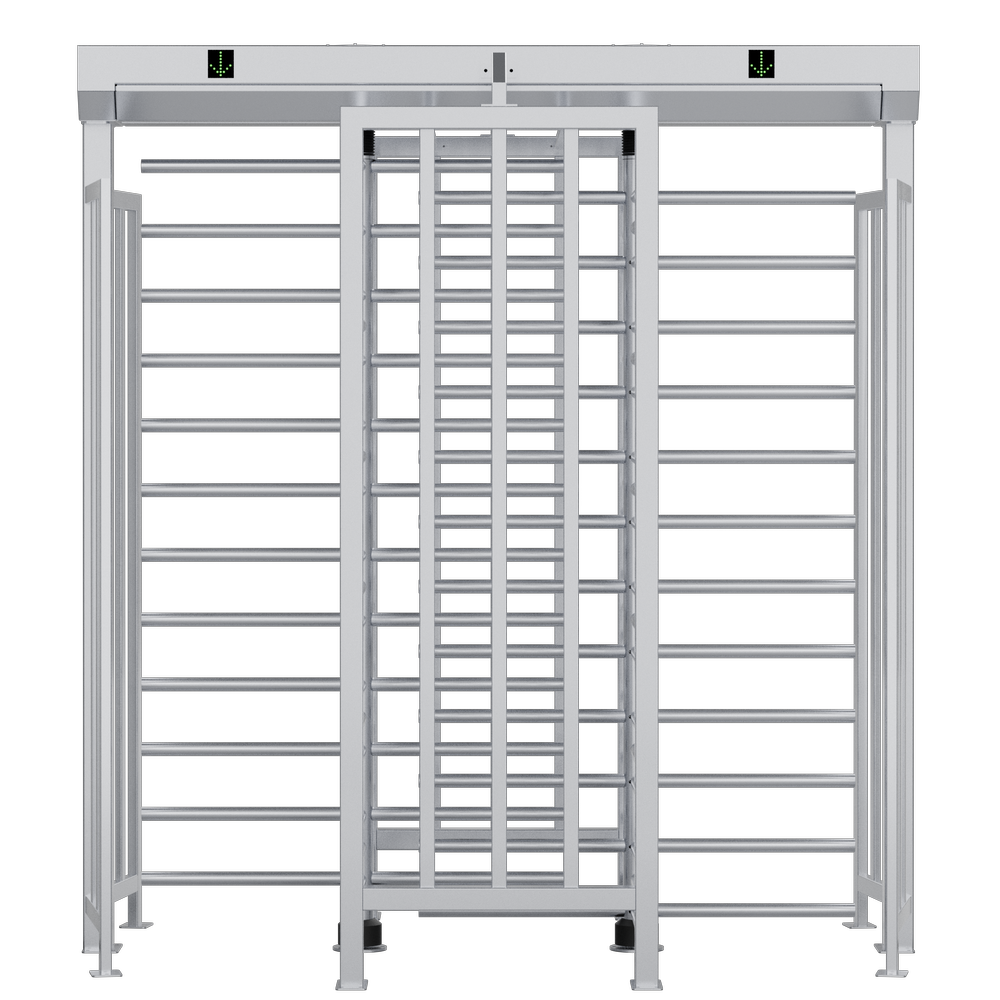
BAL-2-4
These models use four-section rotors. The -1-4 version provides one passage lane and the -2-4 version provides two. Four-section rotors offer a different passage geometry from three-section rotors. The model datasheets specify the motor-assisted ZABR3 mechanism.
BAL-1-S i BAL-2-S

BAL-1-S
Variants for sports venue checkpoints. S models have a four-section rotor, ZABR3 mechanism, and front panel. Consider the operator position, ticket readers, and visual inspection workflow when planning the installation.

BAL-2-S
Variants for sports venue checkpoints. S models have a four-section rotor, ZABR3 mechanism, and front panel. Consider the operator position, ticket readers, and visual inspection workflow when planning the installation.
BAL-1-I i BAL-2-I

BAL-1-I
Special-purpose passages. I models are intended for specialized access arrangements, including combined personnel and goods passage. Compare the precise layouts and dimensions of both versions in the technical documentation. The -1-I and -2-I designations do not necessarily indicate one or two independent lanes.

BAL-2-I
Special-purpose passages. I models are intended for specialized access arrangements, including combined personnel and goods passage. Compare the precise layouts and dimensions of both versions in the technical documentation. The -1-I and -2-I designations do not necessarily indicate one or two independent lanes.
Compare BAL Variants
| Models | Passage Lanes | Rotor or Configuration | Mechanism Listed in Datasheets |
|---|---|---|---|
| BAL-1-3 / BAL-2-3 | 1 / 2 | 3 sections | ZABR3 / GA3 / MA3 |
| BAL-1-4 / BAL-2-4 | 1 / 2 | 4 sections | ZABR3 |
| BAL-1-S / BAL-2-S | 1 / 2 | 4 sections and front panel | ZABR3 |
| BAL-1-I / BAL-2-I | Special configuration | See model drawing | ZABR3 |
The number of passage lanes and the number of rotor sections are different specifications. For I versions, compare dimensions and movement clearance in the drawings. The chosen solution should meet user needs and project requirements.
Select a Mechanism for Your Access Control Requirements
| Mechanism | Assistance | Electronic Control | Directions |
|---|---|---|---|
| ZABR3 | Motor-assisted | Yes | Two |
| GA3 | Spring-assisted | Yes | Two |
| MA3 | Mechanical, spring-operated | No | One |
The comparison of all three mechanisms applies to -1-3 and -2-3 models, whose datasheets list these options. The documentation for the remaining models shown above specifies ZABR3. Do not assume GA3 and MA3 are available across the entire series.
How to Select a BAL Turnstile for Your Installation
Start with the entrance layout, user traffic volume, and authorization method. Check space for the structure, access to the passage, reader mounting, and connection to pedestrian barriers. Provide environmental conditions, available power supply, foundation details, and preferred finish.
Electronically controlled variants require compatible signals from the reader or access controller. Confirm power supply specifications and behavior during a power outage for the exact model and mechanism. MA3 does not have electronic control.
BAL Model Documentation
Select the datasheet and technical drawing for the exact model. Compare overall and passage dimensions, anchor positions, and cable entry locations. The mechanism designation and finish should match the ordered configuration.
Frequently Asked Questions About BAL Turnstiles
What is the difference between BAL-1-3 and BAL-2-3?
BAL-1-3 has one passage lane, while BAL-2-3 has two. Both use three-section rotors. The selected mechanism determines the type of assistance, control capabilities, and permitted travel directions.
What does the number 4 mean in BAL model names?
The -1-4 and -2-4 models use four-section rotors. The -1-4 has one passage lane and the -2-4 has two. Before selecting a model, compare user clearance and overall dimensions in the technical drawings.
Can every BAL model integrate with an access control system?
ZABR3 and GA3 variants feature electronic control for integration with external systems. MA3, available for the specified three-section rotor models, is a one-way mechanism without electronic control.
What are the BAL I and S variants designed for?
I variants are intended for special-purpose passages, including combined personnel and goods access. S variants are designed for sports venue checkpoints and feature a front panel. Accessibility requirements and supervision arrangements must be determined for each facility.
What information should I include in a BAL turnstile inquiry?
Specify the model, if selected, and the number and directions of passage lanes. Include an entrance plan or dimensions, the reader or controller model, installation conditions, and preferred finish. Describe the required behavior during a power outage.
See also other types of gates


Tel: +48 667 964 141
E-mail: sales@gastopgroup.com


